Cultural Triangle
Sigiriya
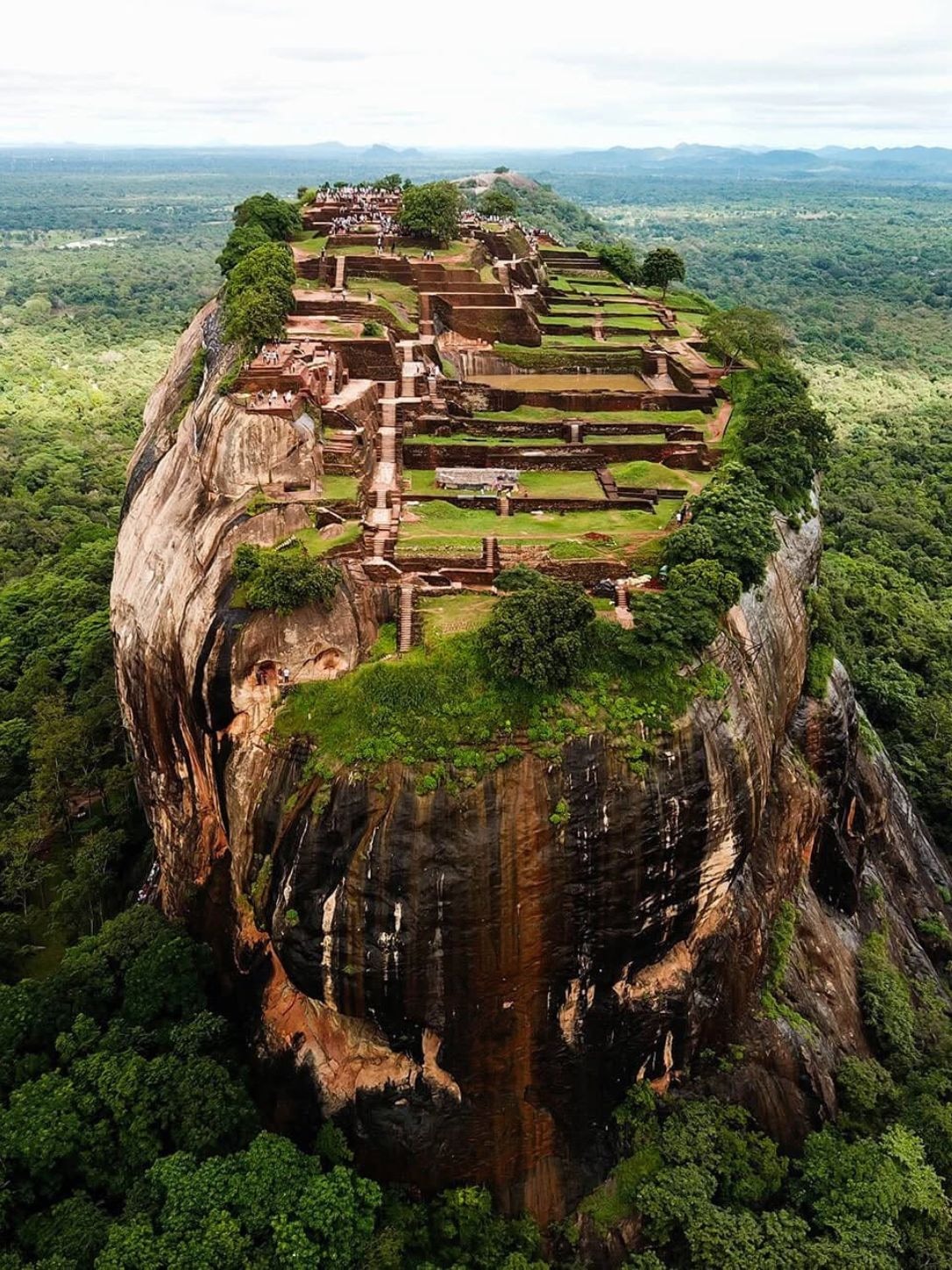
A palace on top of a granite plug, built by a king who killed his father and had eleven years to enjoy the view.
- 2 nights
- Best January to September
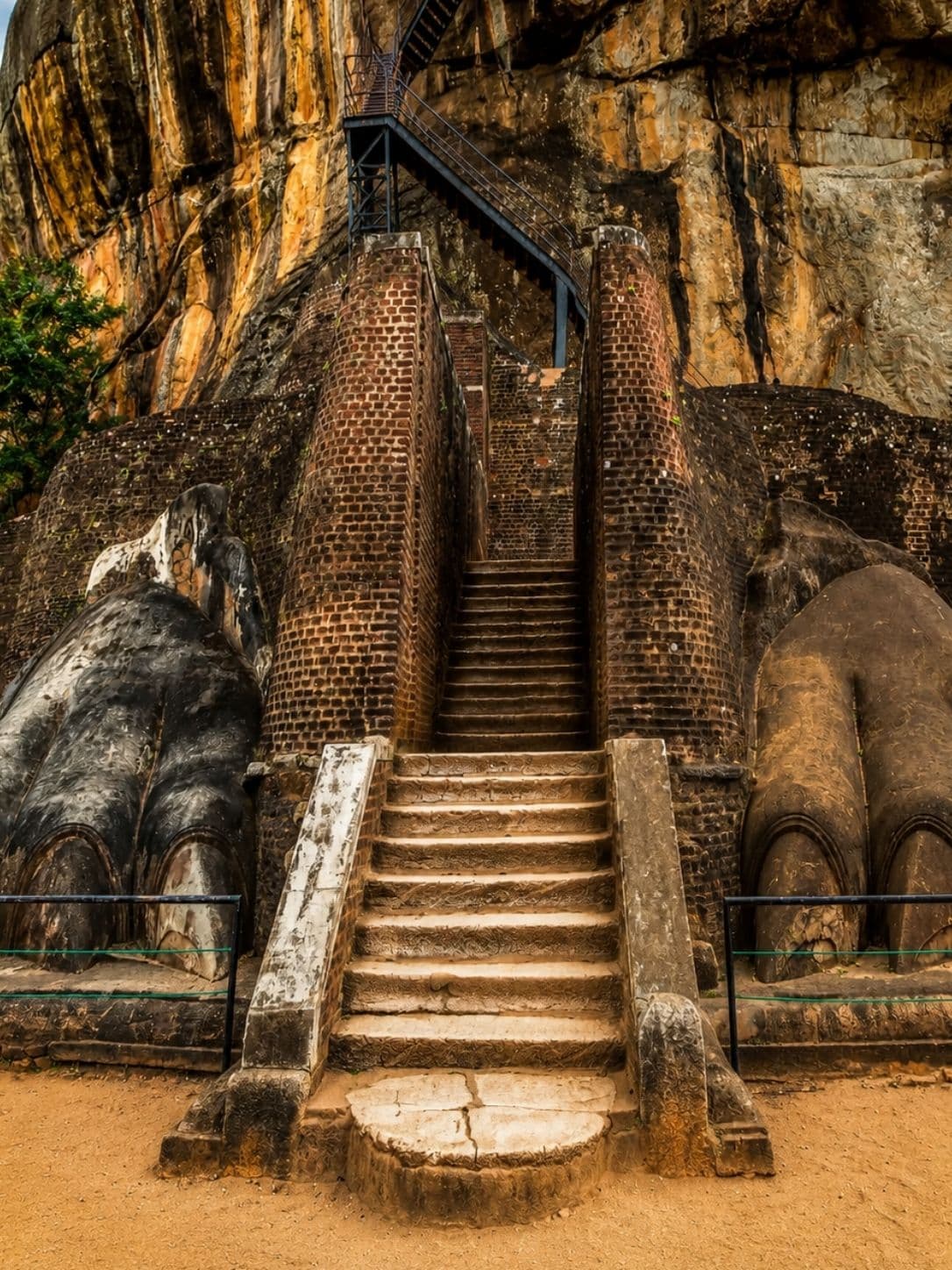
Kassapa took the throne in 477 CE by walling his father up alive, and then — reasonably enough — built himself somewhere defensible. What he left is a two-hundred-metre column of hardened magma with a palace on the summit, approached through water gardens, past a gallery of painted women, and finally through the paws of a brick lion that once had a head.
The climb is about twelve hundred steps and takes most people an hour and a half with stops. But the part that repays attention is not the summit. It is the water gardens at the base, which are symmetrical, hydraulically sophisticated, and still work: after heavy rain the fountains run under nothing but gravity, fifteen centuries after they were cut.
Kassapa lost his kingdom in battle in 495 CE and the site became a monastery again. It was never really lost — pilgrims and monks kept using it — but it was not properly excavated until the British arrived with an interest in archaeology.
Why come here
What Sigiriya is for
- 01
The frescoes
Roughly twenty figures survive in a sheltered pocket halfway up, out of what may once have been five hundred. The pigment is fifteen hundred years old and still reads as skin.
- 02
The mirror wall
A polished plaster wall covered in graffiti left by visitors between the eighth and tenth centuries — verses admiring the paintings. It is the earliest substantial body of written Sinhala.
- 03
The engineering
Boulder gardens, terraced gardens and symmetrical water gardens laid out on an axis, with a hydraulic system that still functions. As a piece of design it is more impressive than the palace.
One caveat
By nine in the morning the staircases are a queue, and the exposed rock face gets extremely hot. If you are not willing to be at the gate when it opens, Pidurangala across the fields gives you the better photograph of Sigiriya itself for a fraction of the ticket price and the crowd.
Top experiences
What we would actually do
Not a list of everything possible — the handful of things we put into itineraries, and when.
First light on the rock
Gates open at seven. Being among the first up means shade on the staircases, birdsong instead of chatter, and the frescoes without a queue behind you.
Pidurangala at dawn
A rougher scramble on the neighbouring outcrop, ending at a reclining Buddha and a flat summit facing Sigiriya. This is where the photograph of the rock comes from.
The water gardens, slowly
Most people walk through these in eight minutes on the way to the stairs. Given half an hour and someone who can explain the hydraulics, they are the most interesting thing on the site.
Minneriya or Kaudulla, late afternoon
Twenty minutes away. In the dry months elephants gather on the receding reservoir bed in numbers that are difficult to believe until you see them.
Highlights
The things themselves
The lion paws
All that remains of a gatehouse shaped like a lion, through whose mouth the final staircase once passed.
The fresco gallery
Reached by a spiral stair bolted to the rock face. Photography is not permitted.
The mirror wall
Still faintly reflective where the plaster survives.
The summit palace
Foundations, a cistern cut into solid rock, and the whole dry zone laid out below.
The water gardens
Fountains, moats and bathing pools on a strict symmetrical axis.
The Sigiriya Museum
Small, well made, and much better visited before the climb than after it.
Working out how many nights Sigiriya is worth?
It is the question we answer most often, and the honest answer changes with what else is on your route. Tell us where else you are going and we will tell you how long to stay here.
Travel information
The practical part
- Suggested duration
2 nights
One dawn for the rock and one for either Pidurangala or a reservoir safari. A single night forces both onto the same morning and neither goes well.
- Best time to visit
January to September
The dry zone runs on the opposite schedule to the southern coast, which is what makes the Cultural Triangle a reliable pairing with a beach stay in almost any month.
When not to come. October to December, when the north-east monsoon makes the rock face slippery and the climb is sometimes closed outright.
Travel tips
- 01
Be at the ticket office before it opens at seven. This single decision changes the experience more than anything else you can control.
- 02
The ticket is expensive by Sri Lankan standards and is priced in dollars. It is not a scam; it genuinely costs that.
- 03
There are hornet nests on the rock face and occasional closures because of them. Guides take this seriously and so should you.
- 04
Take more water than seems necessary. There is no shade above the fresco gallery.
Recommended journeys
Itineraries that include Sigiriya
Each is private and fully adjustable — a shape to start from rather than a package to buy.
Nearby
What pairs with it
Sri Lanka is small, and the best itineraries cluster rather than criss-cross. These are the natural neighbours.
Questions
About Sigiriya
About twelve hundred steps, some of them steep metal staircases fixed to the rock face. Most reasonably fit people manage it in ninety minutes with stops. If you are badly affected by heights, the spiral stair to the frescoes is the section that tends to cause trouble.
They are different things. Sigiriya is the archaeological site; Pidurangala is the viewpoint that looks at it. If you only do one and you care about photographs, do Pidurangala. If you care about the history, do Sigiriya.
Yes, and many people do — Pidurangala at first light, Sigiriya from about half past seven. It makes for a long, hot morning, which is why we prefer to give it two.
Keep reading
More on Sigiriya
Longer pieces from the journal, and the wider trips this place belongs to.
Start planning
Build a journey around Sigiriya.
Tell us when you are thinking of travelling and we will tell you honestly whether Sigiriya is right for those months — and what to pair it with.