Temple of the Tooth in Kandy: how to visit it well
A practical guide to Sri Dalada Maligawa: opening times, dress code, ritual timings, ticket rules and the best way to fit it into a Kandy stay.
The Temple of the Tooth in Kandy is worth visiting if you want to understand Sri Lanka’s religious heart as well as its history. Go for the 6.30 pm evening service if you want the fullest experience, or arrive earlier in the day if you prefer fewer people and a calmer visit.
This is not a museum you rush through in trainers and a sleeveless top. It is an active place of worship, and the visit works best when you plan for the queues, the shoe drop, and the dress code before you arrive.
What is the Temple of the Tooth, exactly?
Sri Dalada Maligawa is the shrine said to house the Sacred Tooth Relic of the Buddha, and that single relic is one reason Kandy became such an important royal and religious centre. The temple is still active, so the atmosphere is not that of a static monument. You are entering a living site of devotion, not just a photo stop.
That matters because the right expectations make the visit far better. You will not be shown the tooth itself. Instead, visitors see the shrine complex, the ceremonial spaces, and, at the right time, the casket area during ritual service. The visit is strongest when you think of it as a ritual experience first and a sightseeing stop second.
The temple also sits at the centre of Kandy’s religious life, which is why it connects naturally with perahera season, the lake, and the old city around it. If you are building a cultural route through Kandy, this is the anchor.
When should you visit for the best experience?
If you want the simplest answer: go in the late afternoon or evening. The official service times are 5.30 am to 7.00 am, 9.30 am to 11.00 am, and 6.30 pm to 8.00 pm. The temple is open daily from 5.30 am to 8.00 pm. (sridaladamaligawa.lk)
The best time depends on what you want:
The official tourism board says the best time to view the casket is around 6.30 pm, which matches what most travellers come for. (srilanka.travel)
That said, the evening slot is also the busiest. If you dislike crowds, arrive early enough to settle in before the service begins, or choose the morning if you care more about space than ceremony.
The best visit is not the one with the most photos; it is the one where you understand what is happening.
What should you wear, and what is not allowed?
Dress modestly. The official FAQ says visitors wearing shorts, sleeveless clothing, or body-revealing attire are not permitted. Appropriate clothing can be obtained at the entrance if needed. (sridaladamaligawa.lk)
A practical outfit rule is simple:
- Shoulders covered
- Legs covered below the knees
- Comfortable footwear that is easy to remove
- Something respectful enough for a religious site, not just a tourist attraction
You do not need to wear white, although many visitors do. White is fine, but it is not a requirement. A modest shirt and trousers, or a skirt or dress that covers the legs, is enough.
Also be aware that footwear must be left at the reception booths. The temple’s guidelines say to hand over footwear, bulky luggage and non-essential items before entering, and the site has separate booths for local devotees and foreign tourists. (sridaladamaligawa.lk)
If you forget something, the temple or nearby vendors may be able to help, but it is better to arrive prepared. In particular, do not assume you can wander in with a large bag and sort it out later.
How do the tickets and entrance rules work?
The official FAQ lists foreign visitor fees as LKR 2,500 for SAARC countries, Thailand and Myanmar, and LKR 3,000 for other foreign countries. The ticket includes the Temple of Tooth Relic, Dalada Museum, World Buddhist Museum, Tusker Museum, and Royal Elephant Stable. The site also says tickets are issued automatically by machines at the temple and that tickets issued elsewhere are not valid. (sridaladamaligawa.lk)
That means three things matter:
- 01Buy from the official system only.
- 02Keep your ticket until you are done.
- 03Allow extra time for screening and bag handling.
There is also security screening at the entrance, and the temple asks visitors to avoid harmful materials such as polythene and plastic. Pets are not allowed. (sridaladamaligawa.lk)
If you are planning a tight Kandy day, do not leave the temple as a quick add-on. The entrance process, ritual timing, and museums together can easily take longer than expected, especially if you visit during the evening service.
What happens during the puja, and should you stay for it?
Yes, if your timing allows, you should stay for a service. The ritual periods are part of why the temple matters. The official FAQ lists the early morning service, middle morning service, and evening service; another official page notes that the casket is best viewed around 6.30 pm. (sridaladamaligawa.lk)
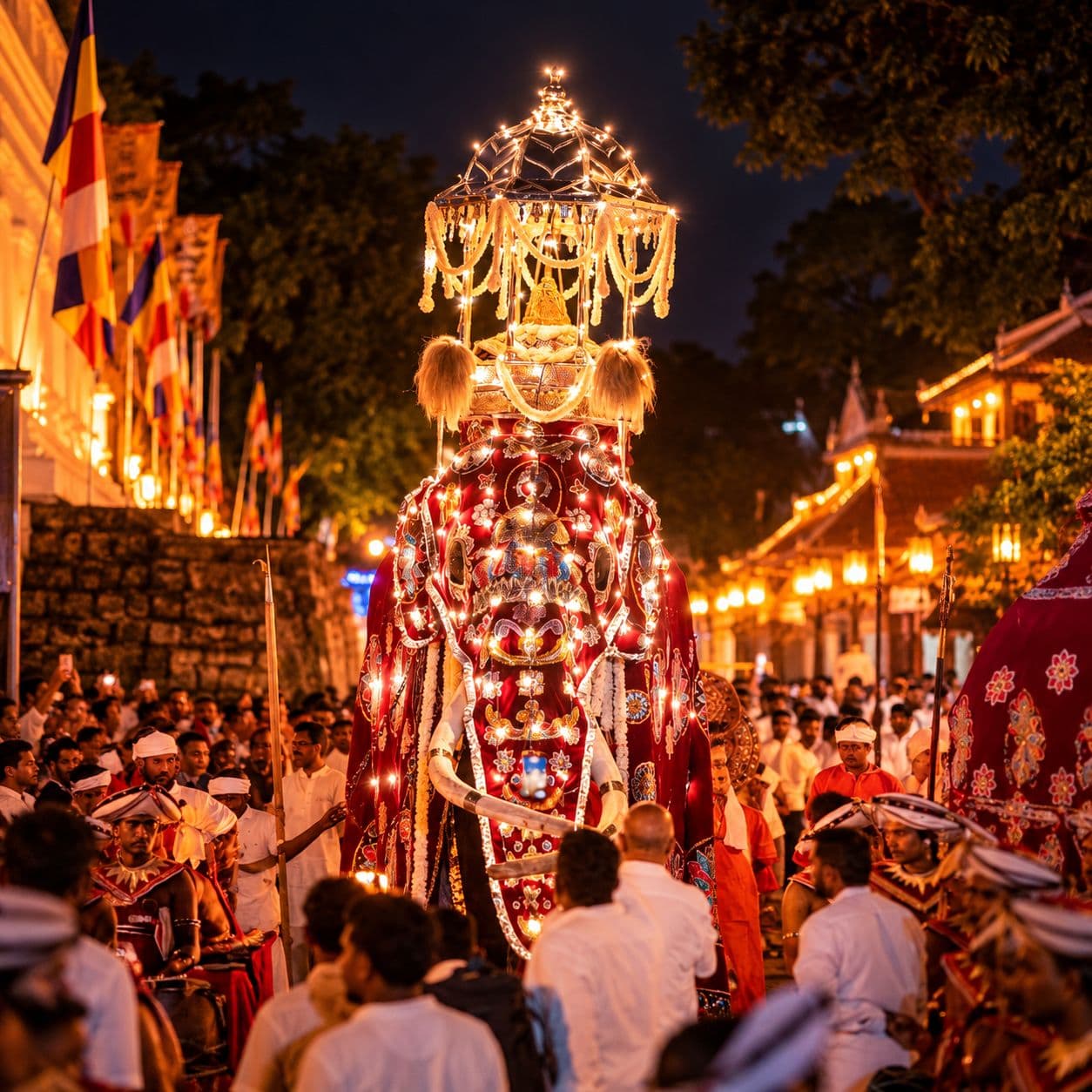
During service, the temple feels more alive: drums, movement, devotees, and a more focused atmosphere. The trade-off is crowding, especially in the evening. If you want a quieter visit with more time to look around, go outside the main ritual windows. If you want the most memorable atmosphere, plan around the evening.
A good way to think about it is this:
- Outside puja times: easier for slow viewing, less crowded, better for travellers who dislike queues
- During puja times: more atmosphere, more people, a stronger sense of place
For most first-time visitors, the evening is the better choice unless you are staying in Kandy on a very tight schedule.
How long should you allow, and what else is worth seeing?
Allow 1.5 to 2.5 hours if you want to visit properly, especially if you include the museums and a slower walk around the grounds. If you only want the shrine itself, you can move faster, but that is rarely the best way to see it.
A sensible visit plan looks like this:
- 01Arrive early and sort footwear and tickets.
- 02Walk through the outer areas slowly.
- 03Time your visit around a service period if you want the ritual element.
- 04Visit the included museums if they interest you.
- 05Leave time for a walk by Kandy Lake or dinner nearby.
The official temple ticket includes several museum spaces, so the visit can be more than a single shrine stop. That is useful if you want to understand the relic’s role in Kandy’s wider history rather than just checking off the headline attraction. (sridaladamaligawa.lk)
If you are based in Kandy for one night, the temple fits naturally into an afternoon and evening plan. If you are only passing through, it is still worth prioritising, but do not squeeze it in between too many other stops. The mood changes when you are rushed.
What mistakes do visitors make most often?
The most common mistakes are easy to avoid:
- Arriving in shorts or sleeveless clothing
- Turning up with no plan for the evening crowd
- Assuming photography is fine everywhere
- Forgetting that the temple is a place of worship, not just a landmark
- Treating the visit as a quick five-minute stop
Photography and videography are permitted outside the temple premises, but the official Siri Dalada Vandanawa FAQ says they are strictly prohibited within the temple premises and that devices must be turned off at the main entrance. (sridaladamaligawa.lk)
That one rule surprises a lot of visitors. If you need photos, get them outside and then put the phone away. Trying to push the rules usually just makes the visit more awkward for everyone.
There is also no vehicle parking within the temple premises, so if you are self-driving or arriving by taxi, you should be ready to park elsewhere in Kandy. (sridaladamaligawa.lk)
Is the Temple of the Tooth worth it if you are not Buddhist?
Yes, but for a different reason. You do not need to be Buddhist to appreciate the temple; you do need to be willing to approach it as a sacred site. The history, architecture, ritual rhythm and role in Sri Lanka’s identity make it one of the country’s most important visits.
If you are a traveller who wants only scenery and quick views, the temple may feel slow. If you enjoy culture, religion, or places where history still shapes daily life, it is one of the most rewarding stops in central Sri Lanka.
It is especially worthwhile if you are already staying in Kandy, planning a central highlands route, or combining culture with tea country. For a tailor-made itinerary, this is the sort of stop that can be placed at the right time of day rather than forced into a packed transfer.
The best version of the visit is simple: arrive dressed properly, choose the right service time, and give the place enough time to feel like more than a checklist item.
FAQ
What time is best to visit the Temple of the Tooth?
The 6.30 pm evening service is usually the best time if you want the full atmosphere. The temple is open from 5.30 am to 8.00 pm, but the evening ritual is the one most travellers plan around. If you prefer fewer people, the early morning or mid-morning sessions are easier.
Can you see the actual tooth relic?
No. Visitors do not view the tooth itself. What you see is the shrine complex and, at the right time, the casket area during ritual service. The value of the visit is the setting, ceremony and significance of the shrine rather than a close-up viewing of the relic.
Is there a dress code for the Temple of the Tooth?
Yes. The official FAQ says shorts, sleeveless tops and body-revealing clothing are not permitted. Shoulders and knees should be covered, and footwear must be removed before entry. If needed, appropriate clothing can be obtained at the entrance.
How much are Temple of the Tooth tickets for foreigners?
The official FAQ lists LKR 2,500 for SAARC countries, Thailand and Myanmar, and LKR 3,000 for other foreign visitors. The ticket includes several related museums and must be bought through the official temple system.
Can you take photos inside the temple?
No. The temple’s Siri Dalada Vandanawa FAQ says photography and videography are permitted outside the premises only, and are strictly prohibited within the temple premises. Devices must be turned off at the main entrance, so plan your photos before and after the visit.
Discussion
Your turn — been there, or heading there?
Questions
What people ask us
The 6.30 pm evening service is usually the best time if you want the full atmosphere. The temple is open from 5.30 am to 8.00 pm, but the evening ritual is the one most travellers plan around. If you prefer fewer people, the early morning or mid-morning sessions are easier.
No. Visitors do not view the tooth itself. What you see is the shrine complex and, at the right time, the casket area during ritual service. The value of the visit is the setting, ceremony and significance of the shrine rather than a close-up viewing of the relic.
Yes. The official FAQ says shorts, sleeveless tops and body-revealing clothing are not permitted. Shoulders and knees should be covered, and footwear must be removed before entry. If needed, appropriate clothing can be obtained at the entrance.
The official FAQ lists LKR 2,500 for SAARC countries, Thailand and Myanmar, and LKR 3,000 for other foreign visitors. The ticket includes several related museums and must be bought through the official temple system.
No. The temple’s Siri Dalada Vandanawa FAQ says photography and videography are permitted outside the premises only, and are strictly prohibited within the temple premises. Devices must be turned off at the main entrance, so plan your photos before and after the visit.
Journeys
Where this turns into a trip
Each is private and fully adjustable — a shape to start from rather than a package.
Places
Mentioned in this piece
Keep reading
More from the journal
Culture5 min read
Is Jaffna worth visiting in December? The weather, the islands, and what the month adds
December is Jaffna's wet season, wettest at the start and easing towards Christmas. The temples, the food and the welcome do not change; the sky and the sea do. Here is when in the month to go, what December adds, and how to plan around the rain.
Culture5 min read
Deepavali in Sri Lanka: how the day unfolds, where to see it, and how to travel around it
Deepavali, the festival of lights, is a public holiday in Sri Lanka on Sunday 8 November 2026. It is celebrated from Jaffna to the tea estates of the hill country, and it is easy to travel through. Here is what happens, where, and how to be a good guest.
Culture6 min read
Polonnaruwa travel guide: a route through the ancient city, tickets, and how to see it before the heat
Polonnaruwa is Sri Lanka's medieval capital, an hour from Sigiriya: palaces, temples and four giant Buddhas carved from one granite face. Here is the route that makes sense of it, what the ticket costs, and why the first hour of the day is the one that matters.
When you are ready
Turn this into a journey.
Tell us roughly when you want to travel and what matters to you, and we will come back with a considered outline.